 Cantus™
Window ready
seconds · lower is betterAn empty song
A beat starter
2.3× sooner than REAPER, 3.2× sooner than FL Studio.
A complete DAW — arrange, record, mix and master — with ten instruments and 42 effects of its own. No account, no subscription, no telemetry.
Windows & LinuxmacOS previewCLAP · VST3 · ARA 2ASIO · WASAPI · PipeWire
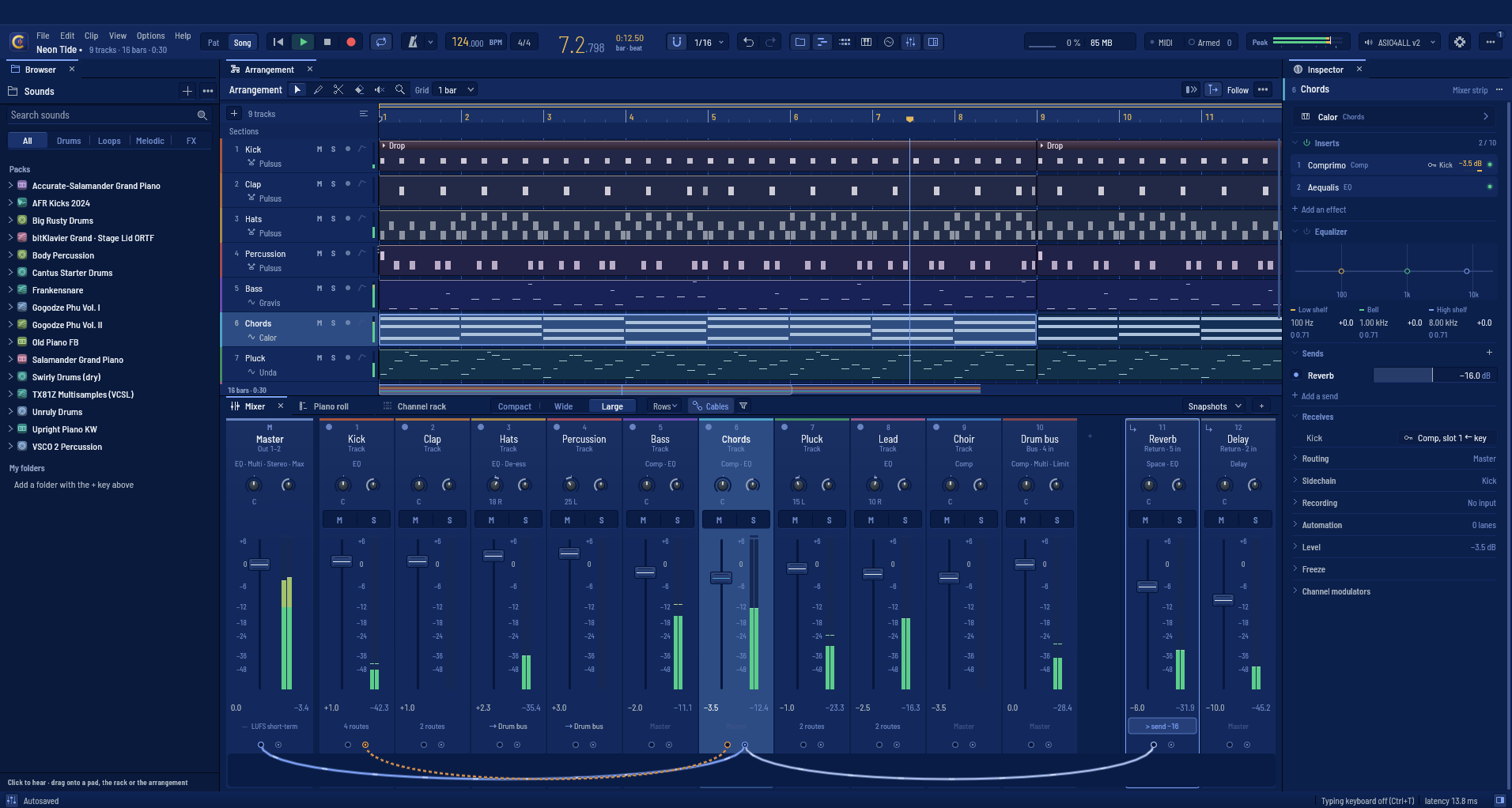
The real program, playing Neon Tide
to a ready window on an empty song — 2.3× sooner than REAPER
sooner than FL Studio, each on a comparable starter
of a core at rest — REAPER 2.3–3.7 %; on a starter 1.7–2.0 % against FL Studio's 6.6 %
of memory on an empty song, down from 237 — REAPER 62 MB; on a starter 143 against FL Studio's 133
Same quiet laptop (AMD Ryzen 7 7735HS, Windows 11), same script, five starts each: Cantus beta 14 on 2026-11-11, REAPER 7.85 and FL Studio 24.1.2 on 2026-11-09. The download is beta 16; these numbers are beta 14's and have not been measured again on beta 16 yet. See how it was measured →
A channel rack like the program's, in your browser: click the cells, change the tempo, press play.
Click any cell. The sound is made in your browser, right now — nothing is downloaded.
Every knob, fader and meter is painted by Cantus's own vector kit, so it stays crisp at any zoom. This is the real program.
Clips on a timeline you can read. Colour-coded tracks, a snapping grid and sections you can name — Intro, Build, Drop — so the shape of the song is always in view.
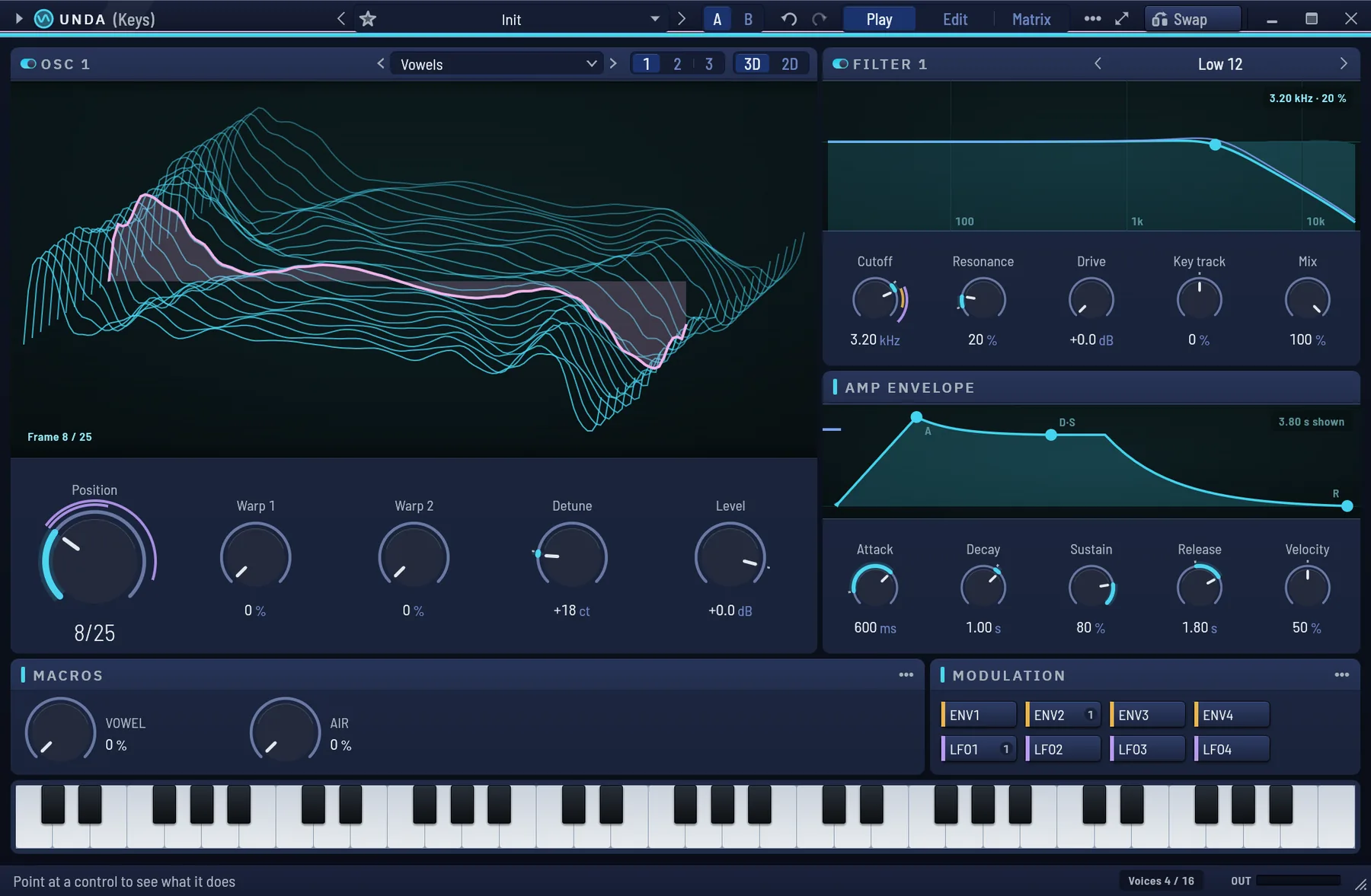
Three wavetable oscillators with additive and granular engines, and Serum and Surge table import.
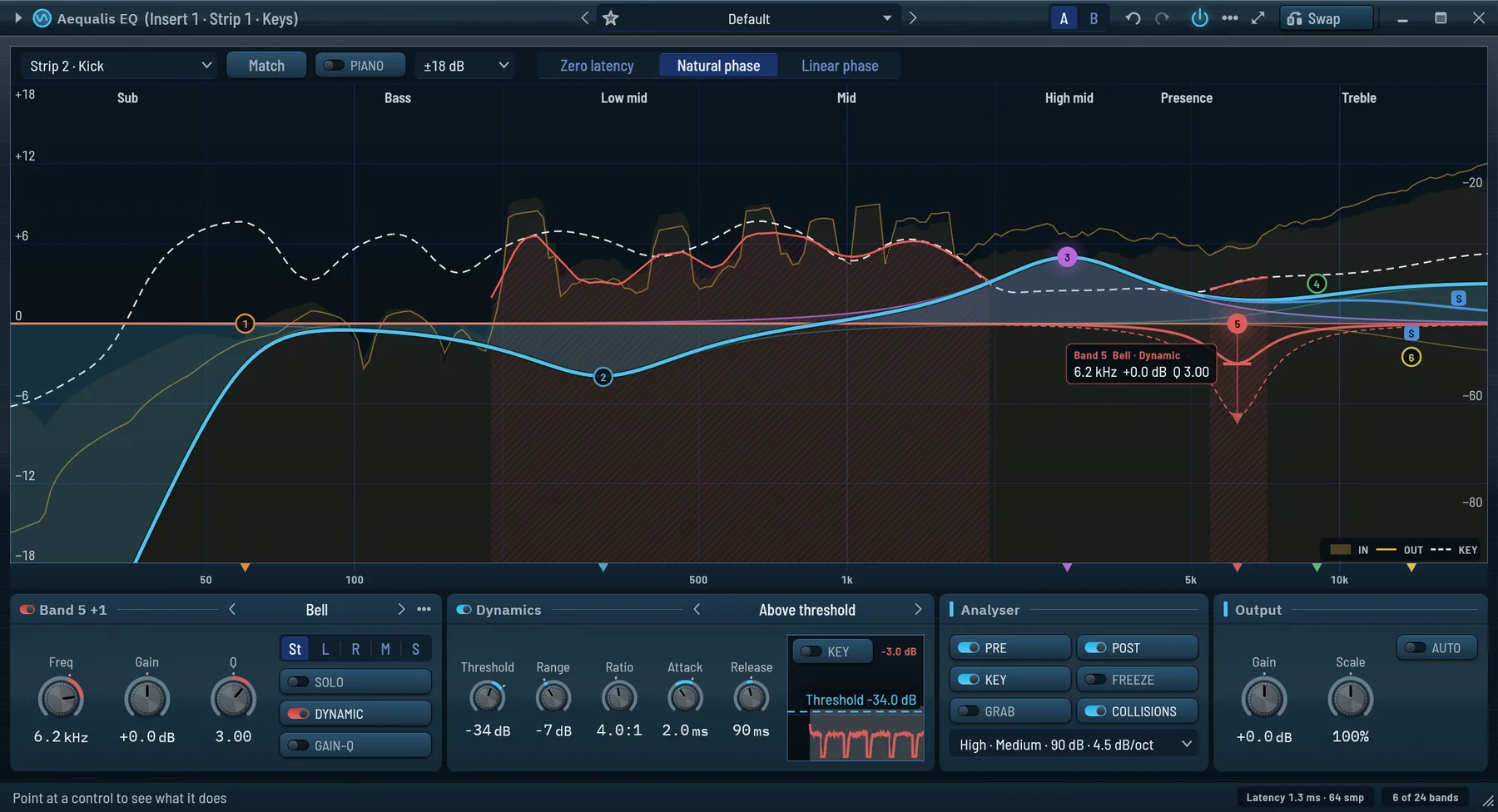
Every preset above is rendered by Cantus itself, with no processing after; the pictures are the program's own windows. Plus Firmus, the simple synth every new track starts with, a plain Reverb, and any CLAP or VST3 plug-in you own.
The same excerpt of a demo song with every slot of one effect bypassed, then as the song ships. Switch while it plays: the music does not move, only the effect comes and goes.
Excerpts of six of the seven demo songs that come with Cantus. Every sound is one of its own instruments and effects, mastered on the song's own master channel.
Cantus, REAPER and FL Studio, five starts each on the same quiet laptop (Cantus beta 14 on 11 November 2026, the others on 9 November), watched by the same script — each beside what it is fair to compare it with. Where Cantus loses, it says so here first.
An empty song
A beat starter
2.3× sooner than REAPER, 3.2× sooner than FL Studio.
An empty song
A beat starter
Done working after it opens: under a tenth of a core, sooner.
An empty song
A beat starter
Every channel that hears silence stops running, to the same bits.
An empty song
A beat starter
Round 39 made the engine's reservation grow with the song: 237 MB became 140 on an empty song (−41 %), 239 became 143 on a starter. About a fifth of what remains is Cantus's own live memory; the rest — the graphics driver's buffers, thread stacks, the audio drivers' heaps — is the work ahead. Still lost, by 78 MB and 10 MB.
97 rows, each from the vendor's own manual
FL Studio, Live, Bitwig, Logic, Cubase, Pro Tools, Studio Pro, REAPER and four free DAWs. Checked 2026-11-04; re-run every release.
The method, the capacity estimate and every row a leader has more:The whole scorecard →
“Whatever you do, work at it with all your heart.”
Cantus 0.1.0-beta.16 · 64-bit
It is a beta: save often and keep backups of your projects.
The newest installer, no administrator rights needed. A portable zip, the plug-ins alone and the SHA-256 sums are on the downloads page. Prefer to build it yourself? The guide in the repository takes you from a clean machine to a running Cantus.
On Windows 10? It has not been tried there yet. Tell us whether it runs — that is how Windows 10 joins the list.
A preview: one universal disk image for Apple silicon and Intel Macs, built and tested on GitHub's macOS machines but not yet opened on a real Mac, and not signed yet. The first time, macOS blocks it: open System Settings → Privacy & Security and choose Open Anyway. Please tell us what goes wrong. Report a problem
Yes. The whole DAW is free and nothing sits behind a paywall. Every sound pack Cantus offers today is free as well — CC0 or CC BY with the credit shown — and downloads only when you ask. Donations may fund the work; they never unlock anything.
There is nothing to sign in to. Your projects, audio and MIDI stay on your computer and Cantus has no telemetry. The privacy notice in the repository says exactly what, if anything, leaves your machine.
It hosts CLAP and VST3 plug-ins, and ARA 2 plug-ins on audio clips; it ships its own effects as CLAP and VST3 so you can use them in other DAWs. ARA hosting is new: tell us which ARA plug-ins you tried and how they behaved.
On Windows, any device through WASAPI and ASIO drivers (ASIO4ALL and the makers' own); on Linux, PipeWire, JACK and ALSA; on the macOS preview, Core Audio. It is a beta and has been tried on a small number of devices, so tell us what you used and how it went.
Yes. Cantus runs on Windows and Linux — an installer for Windows and one AppImage for every Linux distribution, the whole test suite run on both every round — and macOS has a preview: one universal disk image for Apple silicon and Intel, built and tested on GitHub's macOS machines, not yet signed and not yet opened on a real Mac. The first time, macOS blocks it: System Settings → Privacy & Security → Open Anyway. Please report what goes wrong.
Yes. The GPL covers the program, not what you create with it; your songs are yours. Each sound pack states its own licence, so check it for the samples you use.
On GitHub, in the issue tracker. Say what you did, what you expected and what happened. Reports get answered and fixed: the first one, a window that flickered on many screens (14 November 2026), had its cause and a workaround three days later, and the fix shipped in beta 15. See the closed issues.
From the cantus firmus: the fixed melody on which polyphony is built. The engine is that fixed line — deterministic and sample-accurate — and everything else is built on top of it.